Case study 02
Mold remediation
Forced a landlord who'd ignored years of complaints to formally acknowledge a lease violation, prompting professional mold remediation.
- Counterparty
- Oberlin College
- Leverage held
- None safe to spend
- Method
- Evidence + third party
- Result
- 3 buildings remediated
Situation
All of the exposure, none of the control
Oberlin College owned and maintained the buildings OSCA lived in. Under the lease, Oberlin held a duty of care over conditions it alone controlled, while OSCA carried every health consequence of a violation without the right to fix it.
Members had raised mold complaints for years: informal reports, photo evidence passed between cohorts, and a specific dread built into institutional memory — the Fairchild dorm litigation, where mold exposure had been linked to cancer diagnoses in alumni. In facilities meetings, we brought photos to back up our complaints and still couldn't get Oberlin's staff to agree that what they were looking at was mold. None of it moved anyone.
The problem
A valid claim we couldn't safely use
Legally, the question wasn't complicated: negligence requires a duty owed and a breach of it — did Oberlin's response fall below the standard of care a reasonable landlord owes, and did that failure cause real damages? On the record we'd built, the answer was yes.
Having a valid claim wasn't the same as having a safe way to use it. Our formal options ran in order: written notice, code enforcement, and — if Oberlin still refused — depositing our rental payments into escrow. Escrow was the real teeth in that ladder, and the one move we couldn't afford. Oberlin controlled both which students could even join OSCA and which buildings we could rent, including the only ones built for an industrial kitchen. No alternative existed. We had leverage on paper and none we could safely spend.
We had a legal claim and no safe way to use it.
What I did
Three decisions that mattered
None of this was one person's fight — a small team carried it together. My part wasn't in the room with Facilities; it was building the record, briefing the outside inspector, and holding the membership steady while the team negotiated. Three specific things I did:
Compiled the evidence Facilities couldn't lose track of. Pulled every scattered work order into a single spreadsheet — what was reported, when, what was done, what recurred — and periodically resubmitted the same entries into the College's own system to keep them from sinking to the bottom of their work-order heap.
Made sure the outside inspector had context, not just access. The decision to bring in an independent inspector wasn't mine to make. What I did control was what happened once he arrived: leading him through the buildings personally, pointing out points of interest room by room, and giving him context on the larger fight with the College so his report reflected not just what he saw, but why it mattered.
Took on the human side no spreadsheet could handle. While the team worked strategy with the College and membership, my focus was on the ground — fielding student questions and fears in real time, being straight with people about the actual risks, and redirecting a lot of anxious energy toward the specific actions that actually moved the campaign forward.
Outcome
The leverage we never had to spend
The College formally acknowledged the lease violation and contracted professional remediation of the affected buildings. We never touched escrow. The record, the inspector's report, and a membership that stayed with the campaign instead of burning out did what the legal threat alone couldn't: Oberlin formally acknowledged the violation and remediated three buildings — 150 rooms, roughly 300 members — within three months of the notice, before the spring term started.
Even more, the relationship it left behind outlasted the fix. At the beginning of my term as Housing Operations Manager, Oberlin's OSCA Liaison didn't know what OSCA was. But by the end, our leadership team had earned the respect of Oberlin's Facilities team and began negotiating with us as a peer, a shift that carried into the next year's fight over financial aid policy. This campaign taught us what leverage points we could lean on to stand toe-to-toe with Oberlin's corporate lawyer team, as well as the tangible benefits of building rapport with our counterparts on Oberlin's Facilities team.
Artifacts
What the inspector documented
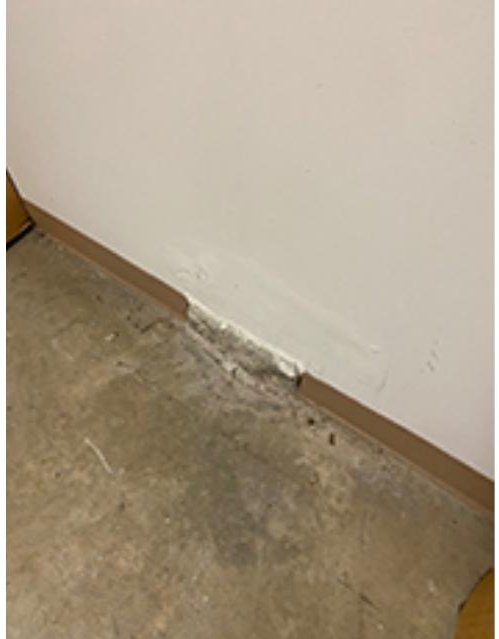
Highlights from the licensed screening inspection of Sept. 25, 2022 — the same conditions Facilities had been shown for years, now recorded by a third party.
1 / 8
Water damaged drywall in basement with likely mold behind it
Evidence
The paper trail
The documents below are the record that moved the institution — the independent screening, the notice of violation, and the itemized list used in notification.
Mold screening inspections, Sept. 25 2022
Licensed third-party inspection report for OSCA buildings.
Open document (PDF) →Lease violation notice, October 2022
Formal notice citing the lease terms breached.
Open document (PDF) →List of violations for notification
Itemized findings compiled for the College and membership.
Open document (PDF) →
What it taught me
Evidence is the leverage
Documentation plus a credible third party can move an institution that has no formal obligation to listen.
Nothing about the underlying facts changed between the years of ignored complaints and the month the College agreed to pay. What changed was the form the facts arrived in.